
Mariya Grinberg | Foreign Affairs
February 3, 2026
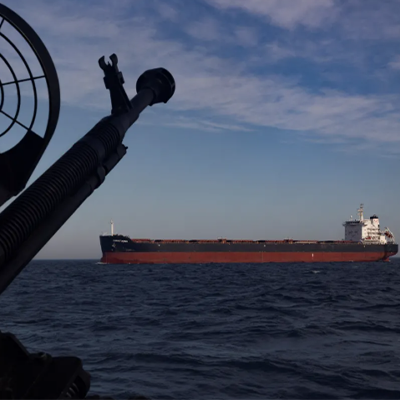
"Trade may not prevent war, but war does not have to stop trade."
- Mariya Grinberg for Foreign Affairs
The Trump administration’s policy toward China remains difficult to parse, but calls to “de-risk” the U.S. economy or even to completely decouple from China still dominate Washington’s strategic debates. Advocates for decoupling urge the United States to revive domestic industries and make them resilient to external shocks, to “friend shore” key supply chains to allies and other well-disposed countries, and to secure reliable access to critical resources. Without such measures, analysts warn, China could strangle the U.S. economy in a crisis. Already, Beijing’s decision in 2025 to block the export of certain rare-earth metals to the United States set alarm bells ringing in Washington. Analysts bemoan the possibility of “weaponized interdependence” and point to the vulnerabilities caused by the entanglement of the American and Chinese economies through globalization. This dynamic can have extreme implications. If a crisis between the United States and China were to somehow escalate to war, China could withhold important materials and components necessary for the defense industrial base, but it could also withhold other critical exports, such as pharmaceuticals.
At the core of this fear is a simple unquestioned assumption: when war starts, trade ends. It is this same assumption that underpins the familiar commercial peace theory that holds that the more countries trade with one another the less likely they are to wage war against one another. But just as it is clear that even high levels of economic interdependence do not foreclose the possibility of hostility between states, so, too, is it the case that countries that are fighting can still maintain commercial ties. States often continue to trade with one another even when they are at war.
Since the Crimean War in 1854, belligerents in most great-power wars chose to maintain their trade ties. Russia in the Crimean War, for example, continued to sell to the United Kingdom many of the raw materials that the British needed for industrial production. At the start of World War I, one of the deadliest conflicts in modern history, the United Kingdom permitted the export of machine guns to its enemies. During the Indo-Pakistani War of 1965, India exported steel, iron, and coal to Pakistan.
The pattern persists to the present day. Trade between India and China actually increased in the early 2020s despite clashes that killed dozens of soldiers in 2020 and an eight-month border standoff between the two states. For nearly three years, from February 2022 to January 2025, Russian gas continued to flow through Ukrainian pipelines even as casualties mounted on the battlefield; Russian oil still flows through Ukraine.
Trade may not prevent war, but war does not have to stop trade. States calibrate their wartime trade to maximize the economic benefits to their domestic economies while minimizing the military advantage that policy provides their adversaries. That nuance allows many countries to keep trading even when they are foes during wartime. By holding on to the erroneous assumption that trade is the first casualty of war, U.S. policymakers risk misjudging what economic coercion can achieve. In doing so, they not only overestimate the leverage China holds in a crisis, they also overestimate the nature of American economic leverage. This mistaken belief can encourage policymakers to pursue costly strategies that promise increased security in theory but may do little to reduce vulnerabilities in practice.
TRADING WITH THE ENEMY
States can keep trading with an adversary in particular circumstances: when trade doesn’t help the enemy win the war and when cutting that trade would be damaging to the state’s long-term security. States have to judge the tradeoffs between the military and economic effects of commerce. All products can ultimately help the enemy’s war effort, but they vary in the amount of time it takes for them to make a difference. Weapons, food, and medical supplies can affect the war as soon as the adversary gets them to the battlefield. Luxury items, such as semiprecious jewels, by contrast, take a much longer time before their circulation in the enemy’s economy can affect battlefield capabilities.
A country could thus determine that it’s safe to trade certain products with an enemy during wartime—trade is permitted if it will take longer for that enemy to convert the gains from trade into military capabilities than the time the war is expected to last. For example, expecting World War I to be a quick war, the United Kingdom started the conflict allowing its firms to export raw materials such as cotton, jute, and steel to Germany, since it would take a while for Germany to make use of those raw materials to support its military.
A state could also choose to keep trading in wartime if it decided that severing trade would fundamentally compromise its long-term security. For example, if a key industry can import something only from the enemy or the key industry produces something so specialized that its sole buyer is the enemy, then severing trade could do permanent damage to a state’s economy—and, therefore, its ability to invest in its long-term security. In the midst of heavy fighting during World War I, the United Kingdom periodically issued licenses to specific firms for the import of German hosiery needles, precision-manufactured metal components integral to the functioning of the British textile industry.
The stakes of the war influence the extent to which the state will protect its domestic industry through wartime trade. In wars that are existential, in which a state is fighting for its very survival, that state will likely stop trading with its adversary even in products essential for key industries. But in wars with lower stakes, states can prioritize their long-term security and maintain such trade. Only as a war becomes more dangerous and threatening do states consider severing trade.
STATE EXPECTATIONS
This logic can be traced through the ongoing war in Ukraine, both in the persistence of trade between the two belligerents and in the sanctions policy designed by Western states against Russia. As the expectations about the length and the stakes of the conflict evolved, so, too, did wartime trade policies.
At the start of the Russian invasion in February 2022, Western intelligence widely anticipated a swift Russian victory, with Kyiv expected to fall within days. Ukraine’s determined resistance, aided by Western weapons and intelligence, stalled the Russian advance toward the capital. By May 2022, two months into the war, expectations shifted toward a longer conflict. The Ukrainian counteroffensive, which retook the Kharkiv region in September 2022, failed to gain momentum, and the war settled into a stalemate. From the end of 2022, both sides dug in for the long haul.
For Ukraine, the war is existential: it is fighting on its own territory in defense of its sovereignty and territorial integrity. For Russia, the stakes are far lower. Although Russia has significant foreign policy interests tied to the outcome of the war, the survival of the Russian state is not directly at risk. For Western countries, the conflict can, at best, be described as a proxy war; they have the lowest at stake of the actors involved.
In the chaos at the start of the war—and with the expectation that total defeat was nigh—Ukraine did not formally restrict its trade relationship with Russia. It only banned direct imports from Russia on April 9, 2022. Direct exports to Russia were prohibited on September 27, 2022, seven months into the conflict. (On Russia’s side, there appear to be no laws prohibiting direct trade with Ukraine.)
Indirect trade between Ukraine and Russia continues. Ukrainian products reach Russian markets through third-party states. For example, in the first year of the war, Ukrainian oil seeds and oleaginous fruits reached Russia through Armenia; sugar syrup through the Czech Republic; plastic stoppers, such as radiator caps, through Kazakhstan; and rubber, used in medical and pharmaceutical contexts, through Estonia.
Trade may not prevent war, but war does not have to stop trade.
The U.S. economic response to the invasion largely conformed to the expected patterns of wartime trade. Initial sanctions on Russia were punitive, seeking to punish Moscow for what was expected to be a Russian fait accompli; there would have been no time for economic measures to affect the battlefield outcome. By May 2022, as policymakers realized that the war would drag on, the United States began to sanction products related to Russian defense production, such as engines, shovels, bulldozers, radio transmitters, and medical and surgical equipment. As the war slumped into a stalemate, sanctions expanded to cover intermediate goods—those products, such as parts for water purifying machines or parts for steam turbines, used as inputs in the making of other goods and services. After about 15 months of warfare, Washington started to target raw materials, such as plastics, rubber, and stone, which take a long time to convert into battlefield capabilities.
Even as the sanctions regime expanded, many of the sanctioned products continued to reach Russia through third-party states. In the first year of the war, Turkey served as an intermediary, providing an indirect channel for trade where direct bilateral ties were severed. For example, American electronic integrated circuits, whose export to Russia was blocked by Washington, still made it to Russian firms through Turkish intermediaries. In subsequent years, some of Russia’s neighbors, including Armenia, Kazakhstan, and Uzbekistan, took on this lucrative role of middle man.
Western countries did not feel greatly threatened by the conflict, and that perception informed the multilateral sanctions regime imposed on Russia. Each country involved in the sanctions regime sought to reduce the economic cost of the policy to themselves, protecting key domestic industries from trade disruptions even though this continued trade contributed to Russia’s war effort. Belgium delayed prohibitions on the import of Russian diamonds for two years. The Czech Republic, Finland, Hungary, and Slovakia continue to import Russian nuclear fuel. Hungary and Slovakia are still importing Russian oil via pipelines. Similarly, the United States still imports palladium, a rare metal, from Russia. These examples demonstrate that states will prioritize protecting domestic industries and thereby strengthen their adversaries—as long as they believe that the stakes of a war are fairly low.
Even as the Europeans consider taking more drastic steps and seizing Russian assets, there is little reason to expect that this general approach will fundamentally change in the future. Western countries have already absorbed the costs of their multilateral sanctions regime, and they seem to have reached the bounds of what is economically tolerable given the stakes of the conflict. Barring a dramatic shift in those stakes, they are unlikely to coalesce around a comprehensive severing of commercial links with Russia.
From Foreign Affairs