
Jennifer Lind & Daryl G. Press | Foreign Affairs
June 24, 2025
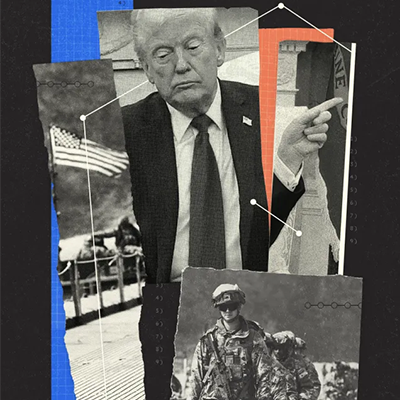
"Instead of trying to create global order, the Trump administration now appears to be pursuing a more focused strategy: prioritization. Its reasoning is simple. The United States has limited resources and China is its greatest geopolitical threat, so Washington must energize recalcitrant allies around the world to manage their own regions, freeing the United States to concentrate on Asia."
-SSP Alum Jennifer Lind & Daryl G. Press in Foreign Affairs
Less than six months into U.S. President Donald Trump’s second term, his administration’s foreign policy has generated widespread dismay and confusion at home and abroad. The use of tariffs against allies and adversaries; the threats to annex Canada, Greenland, and Panama; and the unusually blunt criticism of Washington’s closest partners appear both arbitrary and destructive, especially to policymakers who have spent their professional lives managing the U.S.-led international order. They believe that creating order in a world full of complex transnational challenges requires alliances, credibility, and soft power—precisely what the Trump administration seems bent on destroying.
Aspects of its policies may be difficult to understand, but there is a logic at the core of the administration’s national security strategy. The Trump administration sees the previous U.S. strategy—which aimed to build and maintain a global order led by the United States—as a misguided effort that has sapped U.S. power. It views Washington’s moves to cultivate soft power as leading to meddling and overstretch, and it perceives highly credible American security guarantees as encouraging most of the United States’ allies to reduce their defense efforts and rely on its protection.
Instead of trying to create global order, the Trump administration now appears to be pursuing a more focused strategy: prioritization. Its reasoning is simple. The United States has limited resources and China is its greatest geopolitical threat, so Washington must energize recalcitrant allies around the world to manage their own regions, freeing the United States to concentrate on Asia.
At this early stage, prioritization is only one of several approaches the Trump administration may pursue. But for now, signs of prioritization are evident in the administration’s words and actions. In the Interim National Defense Strategic Guidance, circulated at the Pentagon in March, Secretary of Defense Pete Hegseth described China as “the Department’s sole pacing threat” and the “denial of a Chinese fait accompli seizure of Taiwan—while simultaneously defending the U.S. homeland” as “the Department’s sole pacing scenario.” This echoed ideas promoted for years by Elbridge Colby, who is now the undersecretary of defense for policy and whose 2021 book, The Strategy of Denial: American Defense in an Age of Great Power Conflict, contended that the top priority of U.S. foreign policy was to assemble an “anti-hegemonic coalition” in Asia to prepare for the possibility of “a war with China over Taiwan.”
In practice, the logic of prioritization clarifies many of the Trump administration’s actions with regard to Europe. Tough talk to NATO allies is meant to convince them that they can no longer rely on Washington and must do more for themselves. Ending the war in Ukraine quickly and bringing peace to the continent would enable the United States to reduce its military presence there and focus its resources on Asia. Even the schisms between the United States and Europe over the terms of a settlement between Russia and Ukraine are connected to prioritization. European leaders insist that the U.S. military play a major role in monitoring a peace deal because they desperately want to keep the United States in Europe; the Trump administration wants those responsibilities to rest on European shoulders because it wants out.
The principles of prioritization predate the Trump administration, and they will likely endure beyond it. Every U.S. president since Barack Obama has tried to “pivot” U.S. national security focus from Europe to Asia, because they have all understood that the greater threat to the United States lies in Asia and that U.S. allies in Europe have more capacity to defend themselves. If Trump’s team can make this titanic shift happen—if it can draw down U.S. forces in Europe and concentrate U.S. military strength in Asia—future presidents are unlikely to shift back.
When the United States faced another rising great-power rival, the Soviet Union, in the late 1940s, it adopted a strategy that became known as containment to counter the threat. That strategy was initially flawed but refined over time. The first version of prioritization, too, has important weaknesses. Although the strategy is built on the recognition that U.S. resources are limited, the Trump administration has requested higher defense spending. And although prioritization is designed to prevent China’s domination of East Asia, some of the Trump administration’s policies may be courting unnecessary danger in pursuit of that objective. Policymakers will now have to work through these tensions in the new U.S. strategy. In one form or another, prioritization is here to stay.
From Foreign Affairs