
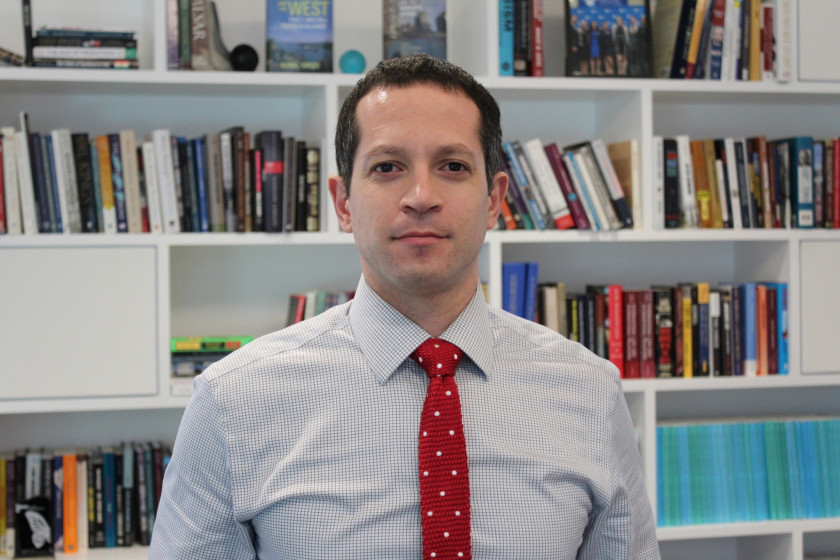
Michael Horowitz
University of Pennsylvania
October 22, 2025 12:00-1:30 PM 600 Technology Square, NE49-3100, Cambridge, MA 02142
Summary:
In this seminar, Professor Horowitz will address the question: are nuclear weapons useful for coercion, and, if so, what factors increase the credibility and effectiveness of nuclear threats? While prominent scholars like Thomas Schelling argue that nuclear brinkmanship, or the manipulation of nuclear risk, can effectively coerce adversaries, others contend nuclear weapons are not effective tools of coercion, especially coercion designed to achieve offensive and revisionist objectives. Simultaneously, there is broad debate about the incorporation of artificial intelligence (AI) into military systems, especially nuclear command and control. We develop a theoretical argument that explicit nuclear threats implemented with automated nuclear launch systems are potentially more credible compared to ambiguous nuclear threats or explicit nuclear threats implemented via non-automated means. By reducing human control over nuclear use, leaders can more effectively tie their hands and thus signal resolve. While automated nuclear weapons launch systems may seem like something out of science fiction, the Soviet Union deployed such a system during the Cold War and the technology necessary to automate the use of force has developed considerably in recent years due to advances in AI. Preregistered survey experiments on an elite sample of United Kingdom Members of Parliament and two public samples of UK citizens provide support for these expectations, showing that, in a limited set of circumstances, nuclear threats backed by AI integration have credibility advantages, no matter how dangerous they may be. The findings Professor Horowitz will discuss in this seminar contribute to the literatures on coercive bargaining, weapons of mass destruction, and emerging technology.
Bio:
Michael C. Horowitz is Director of Perry World House and Richard Perry Professor at the University of Pennsylvania. He is also Senior Fellow for Technology and Innovation at the Council on Foreign Relations (CFR). Prior to returning to the university, he served as Deputy Assistant Secretary of Defense for Force Development and Emerging Capabilities and Director of the Emerging Capabilities Policy Office. He is the author of The Diffusion of Military Power: Causes and Consequences for International Politics, and the co-author of Why Leaders Fight. He won the Karl Deutsch Award given by the International Studies Association for early career contributions to the fields of international relations and peace research. He has published in a wide array of peer reviewed journals and popular outlets. His research interests include the intersection of emerging technologies such as artificial intelligence and robotics with global politics, military innovation, the role of leaders in international politics, and geopolitical forecasting methodology. Professor Horowitz worked for the Office of the Under Secretary of Defense for Policy as a CFR International Affairs Fellow. He is a life member at CFR. Professor Horowitz received his Ph.D. in Government from Harvard University and his B.A. in political science from Emory University.