
Biography
Stephen Van Evera is Professor of Political Science Emeritus. He was previously the Ford International Professor in the MIT Political Science Department. He earned his B.A. in government from Harvard and his M.A. and Ph.D. in political science from the University of California at Berkeley. Prof. Van Evera works in several areas of international relations: the causes and prevention of war, U.S. foreign policy, U.S. security policy, U.S. intervention in the Third World, international relations of the Middle East, and international relations theory. He has published books on the causes of war and on social science methodology, and articles on American foreign policy, American defense policy, nationalism and the causes of war, the origins of World War I, and U.S. strategy in the War on Terror. He currently serves as chair of the Tobin Project committee on national security.
Teaching
Selected Publications
Stephen Van Evera, “Lessons from the Russian Invasion of Ukraine,” Defense Priorities, February 13, 2023 (With Barry Posen at al.)
Stephen Van Evera, “There is no NATO open-door policy,” The Hill, January 27, 2023, (With Michael O’Hanlon)
Stephen Van Evera, “U.S. Social Science and International Relations,” War on the Rocks, February 9, 2015
Stephen Van Evera, “European Militaries and the Origins of World War I,” in Richard N. Rosecrance and Steven E Miller, eds., The Next Great War?: The Roots of World War I and the Risk of U.S.-China Conflict (Belfer Center for Science and International Affairs, 2015)
Stephen Van Evera, “Using U.S. Leverage to Abate Conflicts that Harm U.S. Security,” in Stephen Van Evera and Sidharth Shah, eds., The Prudent Use of Power in American National Security Strategy (Cambridge, MA: Tobin Project, 2010)
Stephen Van Evera, “Public Diplomacy: Ideas for the War of Ideas,” Middle East Policy, Vol. XVI, No. 3 (Fall 2009) (With Peter Krause)
Stephen Van Evera, “A Farewell to Geopolitics,” in Melvyn P. Leffler and Jeffrey W. Legro, eds., To Lead the World: American Strategy after the Bush Doctrine (Oxford, UK: Oxford, 2008)
Stephen Van Evera, “The War on Terror: Forgotten Lessons from WWII” Middle East Policy Vol. 14, No. 2 (Summer 2007)
Stephen Van Evera, “Iraq: Canary in a Coal Mine,” MIT International Review Vol. 1, No. 1 (Spring 2007)
Stephen Van Evera, “Bush Administration, Weak on Terror,” Middle East Policy Vol. 13, No. 4 (Winter 2006)
Stephen Van Evera, “American Foreign policy for the New Era, “in Stephen Van Evera, ed., How to Make America Safe: New Policies for National Security (Cambridge, MA: Tobin Project, 2006)
Stephen Van Evera, “Assessing U.S. Strategy in the War on Terror,” The Annuals of the American Academy of Political and Social Science Vol. 607. No. 1 (September 2006)
Books
-
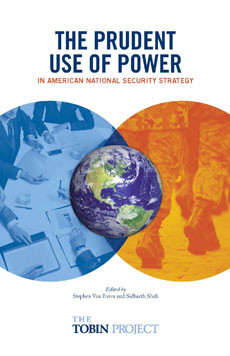
The Prudent Use of Power in American National Security Strategy
Stephen Van Evera and Sidharth Shah
In The Prudent Use of Power in American National Security Strategy, a compendium of ten essays originally presented at the Tobin Project’s December 2009 conference, leading scholars examine the utility of “nonkinetic” (or nonmilitary) power in U.S. national security policy. The authors consider the potential risks and benefits of shifting to a more prudent, or restrained, use of “kinetic” (or military) power in U.S. foreign policy. This scholarship aims to test the limits of kinetic and nonkinetic power in dealing with national security challenges and to explore how and where each can be used most effectively. This compendium brings together a set of scholars from a variety of disciplines, including Jeremi Suri (History, University of Wisconsin, Madison), Carolyne Davidson (History, Yale University), Stephen Van Evera (Political Science, MIT), Daniel Byman (Political Science, Georgetown University), and Deepak Malhotra (Management, Harvard Business School).
-
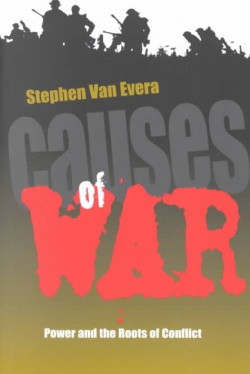
Causes of War: Power and the Roots of Conflict
Stephen Van Evera
What causes war? How can military conflicts best be prevented? In this book, Stephen Van Evera frames five conditions that increase the risk of interstate war: false optimism about the likely outcome of a war, a first-strike advantage, fluctuation in the relative power of states, circumstances that allow nations to parlay one conquest into another, and circumstances that make conquest easy.
According to Van Evera, all but one of these conditions—false optimism—rarely occur today, but policymakers often erroneously believe in their existence. He argues that these misperceptions are responsible for many modern wars, and explores both World Wars, the Korean War, and the 1967 Mideast War as test cases. Finally, he assesses the possibility of nuclear war by applying all five hypotheses to its potential onset. Van Evera's book demonstrates that ideas from the Realist paradigm can offer strong explanations for international conflict and valuable prescriptions for its control.
-
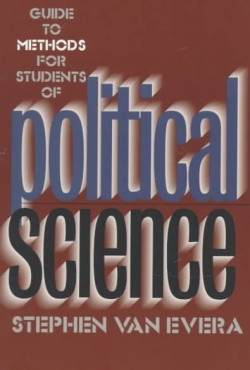
Guide to Methods for Students of Political Science
Stephen Van Evera
Stephen Van Evera greeted new graduate students at MIT with a commonsense introduction to qualitative methods in the social sciences. His helpful hints, always warmly received, grew from a handful of memos to an underground classic primer. That primer evolved into a book of how-to information about graduate study, which is essential reading for graduate students and undergraduates in political science, sociology, anthropology, economics, and history - and for their advisers.
Media
Quoted in "If Russia goes nuclear, how does the West respond?" Eurasianet, March 13, 2023.
Panelist, Columbia SIPA, February 24, 2023, "Nuclear War Theory: Continuity and Change."
Quoted in "Lesson from Ukraine for India and Pakistan - there will be no short wars," ThePrint, February 22, 2023.
Quoted in "NATO's Open Door Policy," Praveen Swami, Malaysian Digest, November 26, 2022.
Panelist, Starr Forum, Center for International Studies, May 21, 2021. "Israelis and Palestinians: Yesterday, Today, and Tomorrow."
Moderator, Starr Forum, Center for International Studies, October 23, 2017. "Syria: Which way forward?"
Jay Talking podcast, September 12, 2019, Victim Ideology, Part 1.
52-Insights.com interview, September 16, 2015, The Rise and Fall of An Empire.
Recent News
-
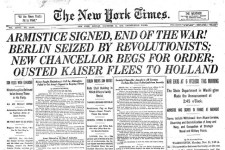
3 Questions: Stephen Van Evera revisits World War I
Michelle English | Center for International Studies
November 8, 2018