
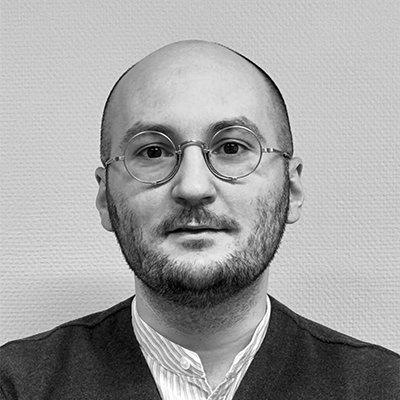
Brice Didier, PhD
2026 Paul (1969) and Melonie Brophy Fellow Research Fellow in European Security
Contact: bdidier@mit.edu | Office: E40-400
Dr. Brice Didier is Paul (1969) and Melonie Brophy Research Fellow in European Security in the MIT Security Studies Program. His research is situated at the intersection of European Union (EU) studies, international relations, European and international security, and foreign policy analysis, and focuses on the EU’s foreign policy and external relations, transatlantic relations, security and strategy.
Brice completed his PhD in political science at the University of Geneva, Switzerland (2024), on the EU’s foreign and security policy and ad hoc initiatives by the 'big' member states, focusing in particular on the 'Balkan Contact Group' on Bosnia and Kosovo, the 'E3' on the Iran nuclear issue, and the 'Normandy' initiative on the Russia-Ukraine conflict in Eastern Ukraine. His research notably won an Ernst and Lucie Schmidheiny grant and a swissuniversities 'Doc.Mobility' scholarship. As part of his doctoral journey, he was a visiting researcher at the European University Institute (EUI) in Florence, Italy, and visiting scholar at the European Parliament Research Service (EPRS) in Brussels, Belgium. His dissertation was awarded the Global Strategy PhD Prize 2024 by the European Security and Defense College (ESDC) and the Egmont Royal Institute for International Relations, for the best PhD on the EU’s foreign, security and defense policy. Brice subsequently completed a postdoc at Sciences Po Paris' Center for International Studies (CERI), notably conducting research on the EU's navigation of the United States-China strategic competition, for which he won a DGRIS-IRSEM 'IR and Strategy' grant. This project was a continuation of the research he conducted prior and in parallel to his PhD, dealing with transatlantic relations and the EU's evolving approach to a shifting world order, for which he notably won the College of Europe’s Sergio Lopez Perona Memorial Prize 2017 and the University Association for Contemporary European Studies (UACES)' Luke Foster Best Article runner-up Prize 2022. Prior to coming to MIT, Brice was a visiting researcher at the University of Edinburgh, UK, notably working on EU-UK foreign and security policy relations, and has been affiliated with the University of Geneva’s Department of Political Science and International Relations.
Brice’s work has notably been published in International Affairs (forthcoming), the Journal of European Integration (forthcoming), European Review of International Studies, Journal of Contemporary European Research, Routledge Studies in Foreign Policy Analysis, and in a number of policy outlets.
Through the course of his academic career to date, Brice has held various teaching positions at the College of Europe in Bruges, Belgium (academic assistant for the joint MA in Transatlantic Affairs with the Fletcher School of Law and Diplomacy at Tufts University in Medford, MA), at the University of Geneva (assistant, teaching and research fellow for the BA in International Relations, then lecturer for the MA in European Studies) including with the Geneva Center for Security Policy (adjunct lecturer for the joint MAS in International Security). His curriculum includes a number of both core and specialized modules in political science, international relations, European and international security, and EU studies, as well as research methods and epistemology – including through supervision. He has also been invited as a guest lecturer in a variety of undergraduate, graduate, doctoral, and executive education programs in Europe.
Prior to his doctorate, Brice graduated from the College of Europe in Bruges (MA in EU International Relations and Diplomacy Studies), the Ecole Normale Supérieure Ulm and Paris 1
Panthéon-Sorbonne University (MA in Geopolitics), and Sciences Po Rennes (MA in European and International Affairs, Master’s in Risk Management, Bachelor’s in Public Administration). He interned at the French Ministry of Foreign Affairs and within its network, and served as a studies officer at the French Institute for Higher National Defense Studies (IHEDN) in Paris, France.