Biography
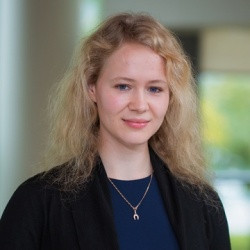
Mariya Grinberg is an associate professor of Political Science at MIT. Her primary research examines why states trade with their enemies, investigating the product level and temporal variation in wartime commercial policies of states vis-a-vis enemy belligerents. Her broader research interests center on the question of how time and uncertainty shape the strategic decisions of states, focusing on order formation, military planning, and questions of state sovereignty. Professor Grinberg earned her PhD in Political Science at the University of Chicago in 2019, and served as a Postdoctoral fellow at the Center for International Security and Cooperation at Stanford University, as well as the Dickey Center for International Understanding at Dartmouth College. She holds an MA from the University of Chicago's Committee on International Relations, and a BA from the University of Southern California. She was a pre-doctoral fellow in the International Security Program at the Belfer Center of Science and International Affairs at Harvard’s Kennedy School in 2018-9, and the Smith Richardson pre-doctoral fellow with the International Security Studies Program at Yale University in 2017-8.
Teaching
-
Political Economy of Security
Selected Publications
Mariya Grinberg, "Sanctions Won't End Russia's War in Ukraine," National Interest, December 24, 2022.
Mariya Grinberg, "Wartime Commercial Policy and Trade between Enemies," International Security Vol. 46, No. 4 (Summer 2021)
Books
-
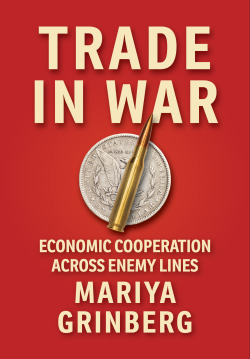
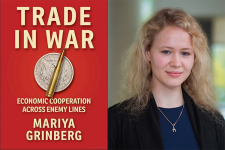
Trade in War: Economic Cooperation Across Enemy Lines
Mariya Grinberg | Cornell Press (2025)
August 29, 2025
Trade in War is an urgent, insightful study of a puzzling wartime phenomenon: states doing business with their enemies.
Trade between belligerents during wartime should not occur. After all, exchanged goods might help enemies secure the upper hand on the battlefield. Yet as history shows, states rarely choose either war or trade. In fact, they frequently engage in both at the same time.
To explain why states trade with their enemies, Mariya Grinberg examines the wartime commercial policies of major powers during the Crimean War, the two World Wars, and several post-1989 wars. She shows that in the face of two competing imperatives—preventing an enemy from increasing its military capabilities, and maintaining its own long-term security through economic exchange—states at war tailor wartime commercial policies around a product's characteristics and war expectations. If a product's conversion time into military capabilities exceeds the war's expected length, then trade in the product can occur, since the product will not have time to affect battlefield outcomes. If a state cannot afford to jeopardize the revenue provided by the traded product, trade in it can also occur.
Grinberg's findings reveal that economic cooperation can thrive even in the most hostile of times—and that interstate conflict might not be as easily deterred by high levels of economic interdependence as is commonly believed. Trade in War compels us to recognize that economic ties between states may be insufficient to stave off war.
Book information: Cornell University Press
Media
Quoted in "Would a U.S.-China War Mean the End of U.S.-China Trade?" Robert Farley. National Interest, January 30, 2024.
Quoted in "Western sanctions fail to benefit Ukraine," Sohail Choudhury, Weekly Blitz, December 29, 2022.
Recent News
-
Grinberg was awarded the J. David Greenstone Book Prize from the American Political Science Association's Politics and History Section
Mariya Grinberg | American Political Science Association
September 15, 2026
-
The Paradox of Wartime Commerce: Why States Keep Trading Even in the Midst of Conflict
Mariya Grinberg | Foreign Affairs
February 3, 2026
-
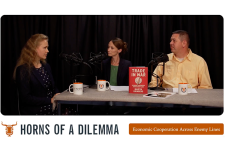
Grinberg: Economic Cooperation Across Enemy Lines
Mariya Grinberg | The University of Texas at Austin's "Horns of Dilemma"
September 9, 2025
-
Mariya Grinberg's New Book Trade in War: Economic Cooperation Across Enemy Lines
Peter Dizikes | MIT News
August 28, 2025
-
Nurturing Success: Professors Mariya Grinberg and Nuh Gedik are honored as “Committed to Caring.”
Jody Mou | MIT News, Office of Graduate Education
September 3, 2024
-
Twenty-three MIT faculty honored as "Committed to Caring" for 2023-25
Office of Graduate Education | MIT News
April 22, 2024